
Discover the artists of SimArts 2026

A few of our Visual Arts students have agreed to speak to us about themselves and their art.

Aseel Alsaman

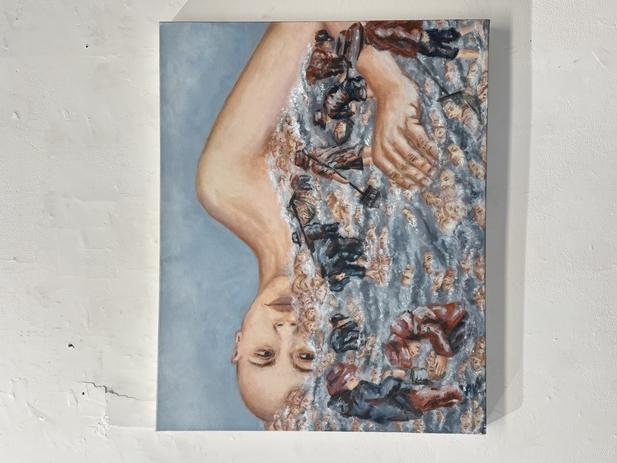
Sea of the Forgotten

Artwork: Sea of the Forgotten

Technique: Oil paint on canvas 
Size: 30" x 24"
Year: 2026

Description of artwork:
The painting captures the deep suffering of families in the Middle East who, driven by war and despair, risk everything to escape across treacherous seas. The calm, reclining figure stands as a silent witness to their pain, her body blending with turbulent waters filled with struggling souls. Figures symbolize those fleeing violence in search of safety, many of whom are lost forever to the vast, unforgiving ocean. The contrast between her stillness and the chaos below underscores a profound sense of memory. The sea becomes both a grave and a passage, holding stories of hope intertwined with fear and grief.

Description of the creative process:
This painting's process started with the memory of what I had been through during the war, and with all the stories I heard at that time about those risking sea crossings for safety. Initial sketches centred on the human figure as a witness and symbol, culminating in a large reclining form that blends with water. Layers of paint created a sense of movement in the sea, with smaller figures added to depict struggle, loss and survival. Throughout, the piece evolved as a reflection on memory, grief, and displacement.

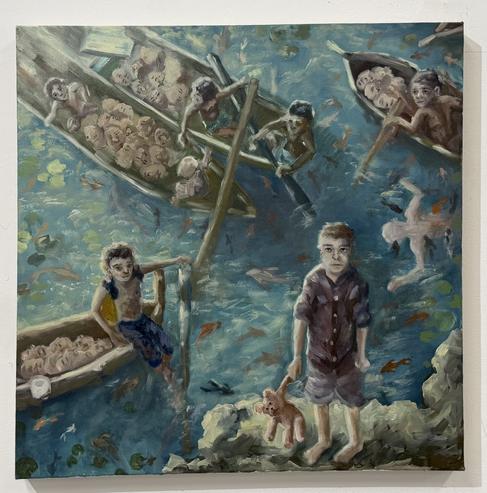
The Forgotten Drift

Artwork: The Forgotten Drift

Technique: Oil paint on canvas 
Size: 24" x 24"
Year: 2026

Description of artwork:
This painting depicts children, many of whom suffered greatly during the war, fleeing across the water in flimsy boats. The scene is filled with movement and tension, as figures struggle for survival while others appear lifeless beneath the surface. In the center, a young boy clings to a stuffed bear, its quiet yet poignant presence a cry for help. The contrast between innocence and devastation underscores the human cost of conflict. Water becomes both a path to safety and a place of loss.

Description of the creative process:
The painting began with the experiences I had, like all refugees who have endured the suffering of war. Initial sketches explored composition, focusing on children as central figures. Layers of paint were built up to create depth in the water and movement in the scene. Figures were added gradually, emphasizing emotion and narrative. The central child was painted last to stabilize the composition and engage the viewer directly.

About the Artist

A bit about yourself:
I am an Iraqi refugee who suffered the horrors and traumas of the Iraq War. During that time, drawing became my only means of expressing the feelings, memories and personal experiences that words could not describe. I found in art a refuge and a new way to understand my reality. It was no longer just a hobby: it became another life through which I could process the pain, reflect on loss, and revive stories that might otherwise have been forgotten.
 

If you could meet any artist dead or living, who would it be?
I would choose Vincent van Gogh for his emotional honesty, his ability to use painting to escape his painful reality, and his ability to translate his inner struggles into a powerful visual language. His work shows that art needs not perfection, aesthetics, or meaningful mastery, but rather honesty. I would like to understand how he continued to create despite hardship and isolation. As someone who uses art to express personal experiences, I feel a deep connection to the intensity and fragility of his emotions, and I believe that learning from his perspective will strengthen my own voice as an artist.
 

How has the visual arts department helped shape you as an artist?
The Visual Arts Department has played a pivotal role in my artistic and intellectual development. Professor Martin, in particular, helped me translate my unfamiliar thoughts and feelings, which I hadn't previously understood, into paintings. The department encouraged me to think deeply about meaning, not just appearance. Through critique and assignments, I learned to communicate ideas more clearly and to dare to experiment with new things in my work. The department also gave me the confidence to use my background and story as part of my artistic voice, helping me develop a more authentic and expressive artistic practice.
Camille Charette

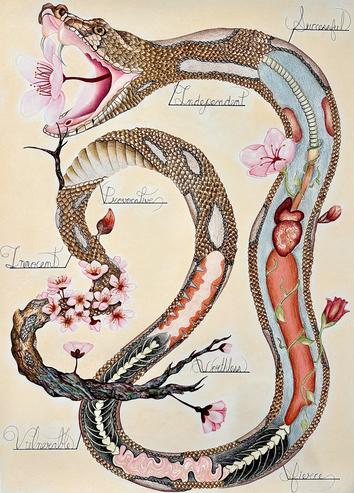
 Personal Mythology: femininity

Artwork: Personal Mythology: femininity

Technique: Coloured pencil drawing on white paper
Size: 22"5 x 30"
Year: 2025

Description of artwork:
This coloured pencil drawing approaches the topic of “Personal Mythology” through femininity in a new light and with a scientific twist. As words emerge out of the paper, resembling annotated scientific illustrations, my work depicts myths and truths about femininity. Symbolically, flowers are delicate and soft, but the snake is protective and strong, which proudly brings up the different parts of who I am as a woman.

Description of the creative process:
The creation of this imaginative and scientific representation was initiated by the assignment topic of ''Personal Mythology'' for drawing class. At first, I stumbled over not knowing my cultural origins, which created a big hesitation on how I was going to represent myself through this drawing. I therefore dug deeper and asked myself what story I could tell my viewer about who I am. That's when femininity emerged, and got me thinking about adding words that might highlight the strengths of being a woman while capturing the hardships we must face.

About the Artist

A bit about yourself:
Art has always been at my core, but it was only in my second year of university that my artistic journey took a turning point when I started studying biology along with my art classes. This change influenced many of my creative projects by mixing art and biology whenever I had the chance. Although I faced many challenges in this process, it has pushed me to grow and discover my artistic style, with the goal of further studying scientific illustration. 

If you could meet any artist dead or living, who would it be?
I would love to meet Chidiebere Ibe, who is a successful 30-year-old Nigerian medical illustrator. He focuses on representing people of colour by advocating for diversity in medical illustrations to improve their health-care outcomes. He has many media coverages about his successful representations and he continuously advocates for inclusion in medicine. His eye-opening story is inspiring, and his talent in beautifully rendered medical images is what I wish to achieve.

How has the visual arts department helped shape you as an artist?
In first year, the Visual Arts Department helped me refine my techniques. In second year, we leaned into a more explorational approach, which tested my creative thinking. In third year, my interest in biological themes emerged, which I explored playfully. In fourth year, I felt more confident to further explore scientific approaches, with the support from my professors really helped me through this journey. Finally, I can confidently say that the Visual Arts Department has made me discover who I am as an artist and how my work can stand out from the crowd by highlighting my strengths

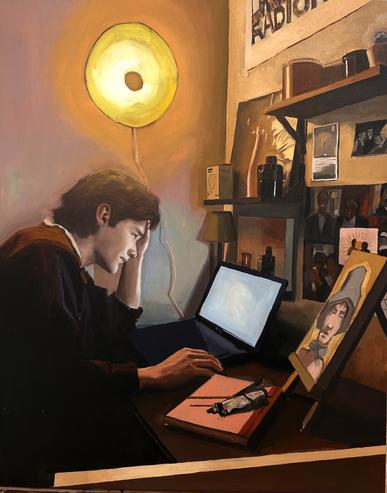
Carter Leynes

 A Working Artist

Artwork: A Working Artist

Technique: Oil paint 
Size: 24" x 32"
Year: 2026

Description of artwork:
My piece entitled “The Working Artist” is meant to represent the frustration I feel with the lack of appreciation our society has for art and artists. I am often overwhelmed by the idea that to live as an artist in this day and age, means pursuing a career in more than just art. Even now as a student, I find myself pulled away from creating by studies I have no interest in, and I resent them from taking me away from my art. But still I appreciate that it gave me the idea for this painting. 

Description of the creative process:
This work was produced in the style of Norman Rockwell. I set up an image, took a photograph, then did a fully rendered drawing on a wood panel in charcoal using the grid method, then I painted over top.

About the Artist

A bit about yourself:
I just started painting last year, although I have been drawing for as long as I can remember. I’ve always had a passion for art but I felt it was unavailable because of the difficulties in having a career, but I’ve decided to pursue it anyways.

If you could meet any artist dead or living, who would it be?
Norman Rockwell

How has the visual arts department helped shape you as an artist?
The Visual Arts Department has given me the opportunity to explore my creative interests and provided me with the tools do so. This program has greatly accelerated my artistic progress and I’ve only finished first year.

Cece Klein

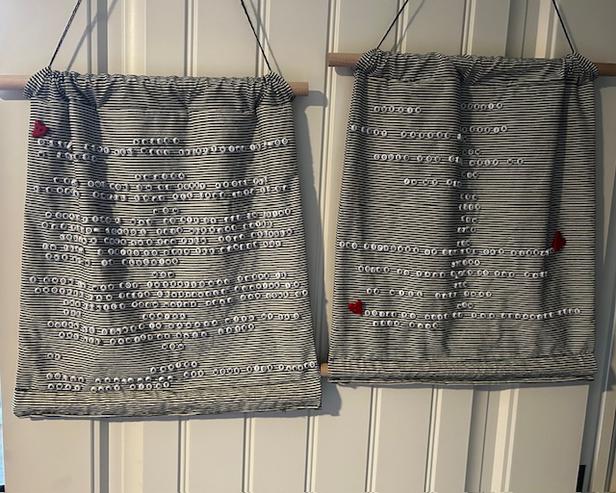
 Roles to Play

Artwork: Roles to Play /Personnages d'un sénario

Technique: Hand sewing and machine sewing, hand-made pottery buttons 
Size: 2 tapestries, 14" x 15" each
Year: 2025

Description of artwork:
The group chat represents connection, love, family. It reminds us what it takes to navigate change, often one character at a time. Three heart emojis (modeled from clay, painted with acrylic) appear in the tapestries. The hearts speak to human relationships and loved ones.

Description of the creative process:
This group chat tells the story of a mother and two daughters as it played out in February 2025. I was thinking about the things that we say to each other, and wanted the piece to reflect changes to how we communicate with each other. We are ordinary people doing ordinary things. I made my clay buttons in the pottery studio. I incorporated store-bought lettering with a needle and thread, using a paper chart for bead placement. I cut dowels in the wood shop. I machine-sewed the casing. I spoke with my adult children about the work.

About the Artist

A bit about yourself:
My work is about memory and change. I am an older student, about half-way through the BFA program.

If you could meet any artist dead or living, who would it be?
If I could meet any artist, dead or alive, I would choose the extraordinary light that was Kenojuak Ashevak (1927-2013, Inuk artist).

How has the visual arts department helped shape you as an artist?
The Visual Arts Department has helped shape me as an artist with encouragement; providing tools to improve/edit my own work and to more richly experience the work of others; by teaching me how to build things up, take them down, and build them up again; confidence, support, kindness and community.

Charles Lin

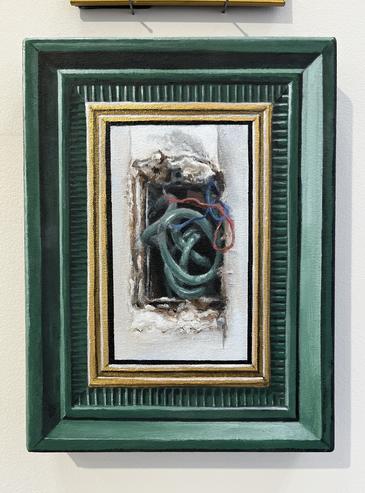
 Portrait of a Socket

Artwork: Portrait of a Socket

Technique: Acrylic on canvas 
Size: 9" x 12"
Year: 2026

Description of artwork:
A painting of a ripped-out wall socket, in a tromp l'oeil style painted frame.

Description of the creative process:
I like taking pre-established techniques/ideas and giving them a more contemporary twist. I like subjects that are unorthodox and a bit grimy. I like the ideas of combining old-timey gravitas with things that should have none of those traits, and somewhere along the way, it all culminated into this piece.

About the Artist

A bit about yourself:
By the time this is published, I will have graduated from uOttawa. I probably will focus more on digital art in the future, but I still want to continue with acrylic and graphite and all that jazz. I am still figuring things out, but whatever happens, I hope art can be a major part of it.

If you could meet any artist dead or living, who would it be?
For more traditional artists, I'd say people like Milic od Macve, Honoré Daumier, JMW Turner, Alex Janvier, Zhang DaQian, and Franklin Carmichael. There are also a bunch of internet artists that I think might be fun to talk to and meet. I generally like art and artists that are a bit more obscure and have an expressiveness to their work.  

How has the visual arts department helped shape you as an artist?
I made some connections (both profs and students), got much better at painting and drawing. I feel like I am allowed the space to be more expressive with my style and scale.  

Eva Ma

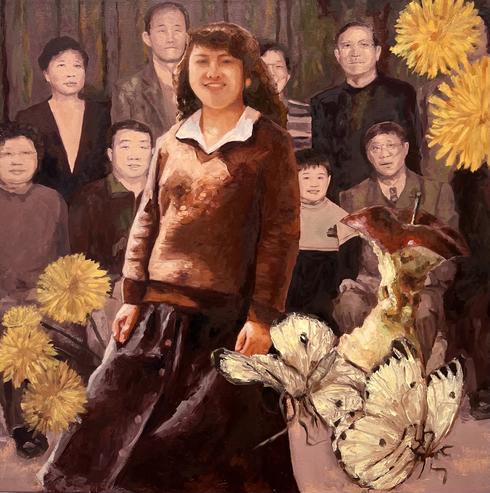
 A Better Life

Artwork: A Better Life

Technique: Oil on canvas 
Size: 30" x 30"
Year: 2025

Description of artwork:
A Better Life reflects my mother's immigration from China to Canada. At the forefront she stands vibrant and full of colour, while a muted, old-photo-style portrait rests behind her, representing the life that was left behind. The portrait is divided into two sides: relatives I've come to know on the left, and figures I've only ever seen in photographs on the right. Two figures are hidden by dandelions, signifying survival in unlikely environments. The apple core represents the absence of care after my mother left home. The moths are forms of freedom, light and possibility.

Description of the creative process:
This painting was built from old family photographs and conversations with my mother. Many of the symbols emerged directly from those interviews: the dandelion came from hearing her describe feeling as though she was a weed where it was not supposed to grow. The apple core refers to a familiar gesture in many Asian households, where parents express love not through words but through a plate of freshly cut fruit, and to her memory of losing that after she left home. The photographs gave me faces. The interviews gave me context for what those faces and everything in between.

About the Artist

A bit about yourself:
I'm an oil painter who loves capturing light, textures, colours, and stories of everyday life, turning simple moments and memories into vibrant paintings. I originally worked in digital art, but over time, I gradually transitioned to painting as I explored my long-term goals as a creative professional. I have experience working with children and am passionate about art education, which I hope to pursue in the future! For now, I’m focused on developing my skills and creating art that connects with others.

If you could meet any artist dead or living, who would it be?
I would love to meet Hung Liu. She was a Chinese painter, painting from photographs of people history forgot such as peasants, refugees, and sex workers. She always let the image dissolve at the edges, using washes and letting the pigment drip like memory loosening. I want to ask her how she held that weight. How do you honor someone through paint without flattening them? I think she knew. I want to know too. 

How has the visual arts department helped shape you as an artist?
The Visual Arts department has shaped me in ways I didn't expect. The small class sizes create a real sense of community and professors know your work, your process, your goals, and show up for you consistently. What I value most is the program's openness: there's no single mold to fit, which means growth feels genuinely self-directed. I've had to define my own standards and push myself further because of it. That combination of close mentorship and creative freedom has been foundational to who I am as an artist!

Ivanka Hrycaj

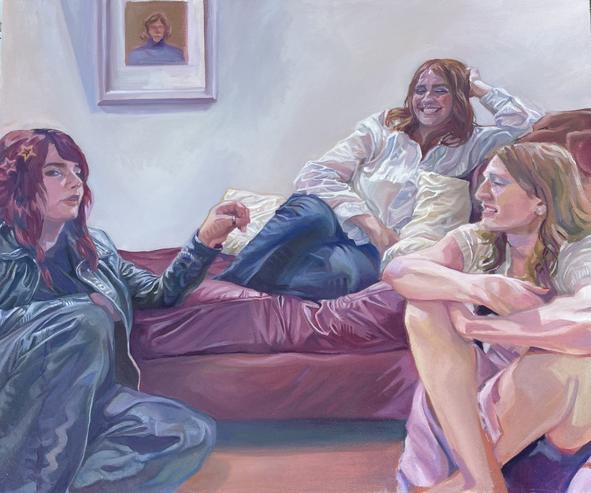
Conversation

Artwork: Conversation 

Technique: Oil on canvas 
Size: 24" x 20"
Year: 2025

Description of artwork:
This oil painting of three friends hanging out after a night out captures the easy conversations that occur when we gather together spontaneously. It was one of my first oil paintings. 

Description of the creative process:
For these two paintings I found inspiration in meaningful moments with my friends. We often take photos when together, and I was able to interpret them in my own ways by mixing in and adding certain elements. 

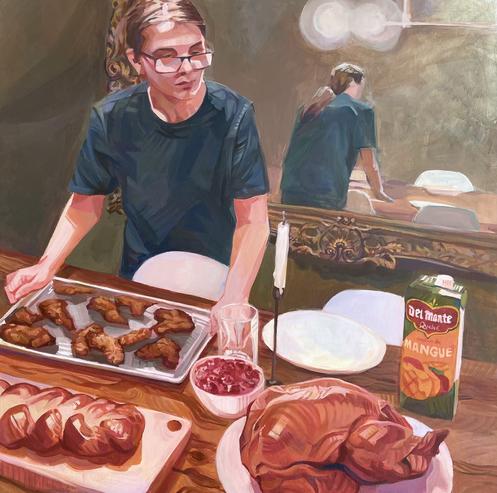
Leo

Artwork: Leo

Technique: Acrylic on wood panel
Size: 24" × 24"
Year: 2025

Description of artwork:
I based this acrylic painting on the celebration of the start of a new year with friends and homemade food. The spread of food is abundant and representative of the joy that fills us when gathering together.

Description of the creative process:
For these two paintings I found inspiration in meaningful moments with my friends. We often take photos when together, and I was able to interpret them in my own ways by mixing in and adding certain elements.

About the Artist

A bit about yourself:
I have completed the second year of my BFA at the University of Ottawa. I mainly focus on painting figurative works, in both acrylic and oil. 

If you could meet any artist dead or living, who would it be?
I would want to meet Van Gogh as I like his use of colours. 

How has the visual arts department helped shape you as an artist?
The Visual Arts Department at the University of Ottawa has allowed me to expand and enhance my practice of art over the past two years. In particular, I have appreciated working alongside other art students and learning from them. 

Jeongmin Seo

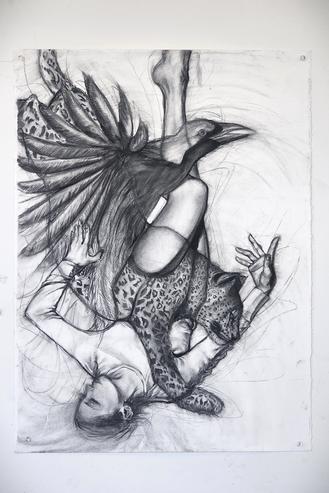
 Move and Feel

Artwork: Move and Feel

Technique: Charcoal, conté, and semi-hard pastel on Stonehenge paper 
Size: 22" x 30"
Year: 2026

Description of artwork:
This charcoal drawing explores the blurred boundaries between humans and animals. Inspired by the emotion and movement of ballet and contemporary dance, I combined a dancer, a leopard, and a bird of paradise into one layered composition. Even though the figures overlap, their forms and outlines are still visible, so each figure remains present within the image. The combination may seem unusual, but I wanted them to create a new shared form together. Through their layered bodies and connected movement, the work shows a moment where different beings find harmony and tension, continue their own fluid movement as one.

Description of the creative process:
I started by sketching each figure separately to decide their forms and composition. I chose charcoal because it is a flexible medium for creating blur, movement and layers. Then I combined the figures into one composition using transparent layered marks and transparent outlines. I kept each outline visible instead of fully blurring their boundaries, while allowing some parts to overlap above or below others so the forms could support one another. To show movement, I kept some sketch lines and smudged the outer contours by hand.

About the Artist

A bit about yourself:
My name is Jeongmin Seo, and I am a BFA student. I am currently studying and exploring how to express my thoughts, impressions and movement through art. My practice focuses on experimenting with different media, especially digital art, drawing and painting. I am still developing my own visual language, but I am interested in how emotion, form and movement can come together in an artwork.

If you could meet any artist dead or living, who would it be?
I would like to meet Alphonse Mucha if I could meet any artist, living or dead. His Art Nouveau illustrations inspire me due to their harmonious combination of figures, objects, decorative patterns and graphic design. His work feels both beautiful and carefully structured, which connects with my interest in fine art and design. It would be a pleasure to speak with him about his artistic vision, his creative process, as well as how he balanced beauty, composition and visual storytelling.

How has the visual arts department helped shape you as an artist?
The Visual Arts Department has helped me develop as an artist through its BFA program, studio art courses and other art-related courses. Throughout these experiences, I have been exposed to new perspectives and have been able to share my work with others through critiques with other artists. The ability to see how other artists think and create has enabled me to broaden my own artistic perspective. The program has also provided me with the opportunity to improve my technique and think about how traditional art practices can coexist with new and developing technologies.

Khanh Nguyen

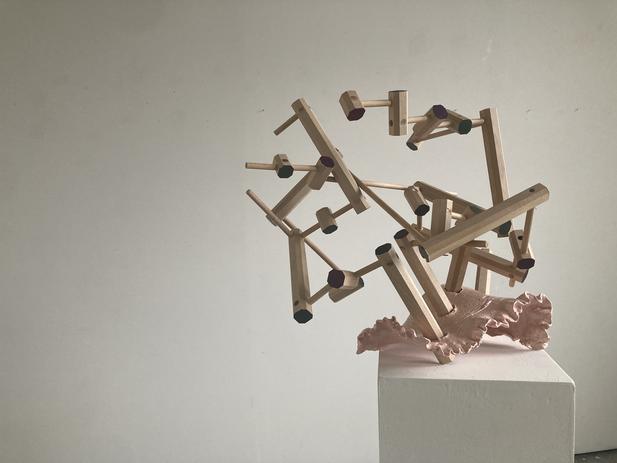
Wooden Desk

Artwork: Wooden Desk

Technique: Ceramic and maple wood 
Size: 18" x 20"
Year: 2025

Description of artwork:
Wooden Desk is made of clay and maple wood. The wooden part is from a thrifted wine rack from the thrift store, which I then disassembled and rearranged.

Description of the creative process:
This sculpture was for the final project in a second-year sculpture class that I took in the fall semester of 2025, taught by Professor Jerome Havre. The assignment's topic was “unstable situation”. I sketched the sculpture’s structure based on the anxious feeling that I had on the first day of elementary school. Essentially, I approached the design through the process of reduction, where I reduced the image of an old-school double, wooden school desk into simple geometric shapes. I then rearranged these shapes to arrive at a final composition/design that represents the wooden desk.

About the Artist

A bit about yourself:
I am a fourth-year BFA student. My media of practice and interest are currently painting with acrylic and sculpting with metal, clay, wood, yarn and ready-made objects. In my artistic practice of sculpture, I aim to reuse and fabricate thrifted objects. I also take on the direction of abstraction and design in my sculptural practice. In painting, I pursue figurative and surrealism achieved from experimental collage works with images cut from National Geographic magazines.

If you could meet any artist dead or living, who would it be?
I would like to meet Mona Hatoum. She is a contemporary Palestinian artist working with installation, photography, sculpture and media.

How has the visual arts department helped shape you as an artist?
The department has helped me grow as an artist in terms of being intentional with the development of my works. My ideas and approaches to different projects in my classes were being challenged by the professors. It was through this tension that I developed a more mature way of thinking when creating a sculptural work. I learned to be thoughtful about every aspect of an art project, whether it be a painting, an installation, a public art proposal or a sculpture. Art history classes help me be aware of social injustice and how contemporary artists respond to social unrest.

Kristina Fobes

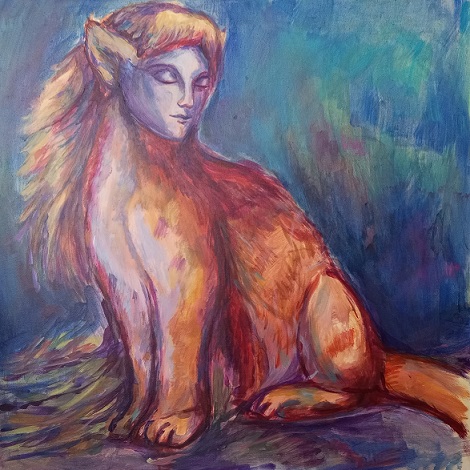
 Sphinx

Artwork: Sphinx

Technique: Acrylic on canvas 
Size: 20" x 20"
Year: 2026

Description of artwork:
A cat-human hybrid sits in serene contemplation.

Description of the creative process:
For this painting of a sphinx, I was inspired by surrealist art, Greek sculpture and a love for cats. I wished for the painting to have a feeling of serenity as well as a bit of a sense of strangeness.

About the Artist

A bit about yourself:
I am currently a BFA student at the University of Ottawa, reaching the end of my third year. The mediums I am most drawn to are drawing and painting. I am very inspired by myths and stories, both in visual mediums like art or film, as well as the written word, especially in the genres of fantasy and science fiction.

If you could meet any artist dead or living, who would it be?
If I could speak to any artist I think I would talk to Leonora Carrington. I admire her work a lot and I think she probably knew many secrets.

How has the visual arts department helped shape you as an artist?
The Visual Arts department has helped me with figuring out what kind of artwork I wish to pursue creating. Before starting my degree, I feel like my ideas were more diffuse and all over the place, not particularly well-realized. Now I feel like I have committed myself way more to trying to find out the best ways to express myself with every piece of art.  

Lauren Paquette

Immortality

Artwork: Immortality

Technique: Acrylic 
Size: 16" x 20"
Year: 2025

Description of artwork:
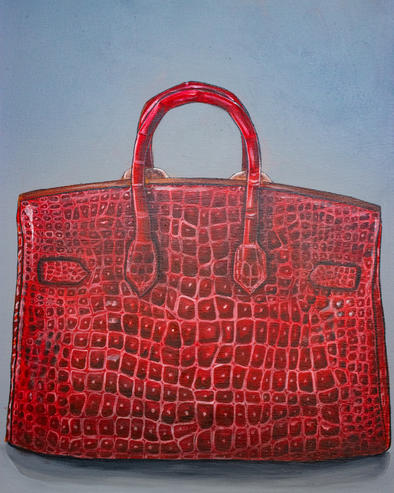
Immortality is about what we can and can't control after our demise─namely how we live on, are (or are not) celebrated and remembered. The crocodile didn't dream of becoming a Birkin, but that was its outcome. A part of it lives on in a reality it could not comprehend. Some humans want to live forever, but what that ends up representing could be far from what was hoped. 

Description of the creative process:
For this piece I chose to reference an Hermes red crocodile handbag. I sketched the purse out freehand, then applied a burnt sienna wash to unite the future colours. I then painted mulitple layers of acrylic paint from base colours to specific shades. The background is a simple grey mixed from dark brown and phthalo blue. I kept the background simple to highlight the crocodile skin.

About the Artist

A bit about yourself:
I am a mature student just completing their second year of a BFA. I love to paint and am really looking forward to taking my art more seriously.

If you could meet any artist dead or living, who would it be?
Wassily Kandinsky since he's responsible for my most favourite painting "Composition VII". I appreciate the joining of artistic creation to the spiritual.

How has the visual arts department helped shape you as an artist?
The Visual Arts Department has made me take my art more seriously by interrogating my own motivations, values and interests.

Maria Luiza Reis

 I Open Myself to You

Artwork: I Open Myself to You

Technique: Acrylic on canvas
Size: 16"
Year: 2026

Description of artwork:
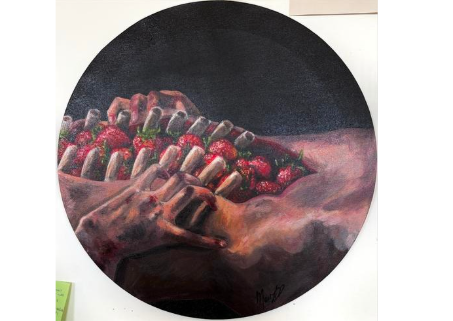
This painting depicts a woman physically tearing open her chest to reveal strawberries in place of her internal organs. The imagery merges visceral gore with delicate beauty, creating a striking contrast between pain and sweetness. The act of opening her chest represents extreme vulnerability and self-exposure, reflecting the experience of people-pleasing: giving oneself fully to others, often at personal cost. The strawberries symbolize the emotional richness and kindness someone may carry within—the “sweetness” of their inner self.

Description of the creative process:
The initial concept for this piece began with a more literal approach: I planned to depict anatomical organs intertwined with strawberries to directly represent the idea of inner sweetness. However, I realized that this approach felt overly explicit and limited the viewer’s interpretation. Instead, I shifted toward a more symbolic and emotionally driven composition. By removing the depiction of realistic internal organs and replacing them entirely with strawberries, the imagery becomes less about anatomy and more about metaphor.

About the Artist

A bit about yourself:
I am a third-year visual arts student with a strong interest in Renaissance art and its focus on realism, anatomy and dramatic composition. My work is influenced by this tradition, but I aim to balance technical realism with visible painterly qualities, allowing the viewer to recognize both the illusion and the hand behind it.

If you could meet any artist dead or living, who would it be?
If I could meet any artist, it would be Alexandre Cabaret. I’m drawn to his work because of the way he blends classical, almost Renaissance art-inspired techniques with unsettling and surreal imagery. His ability to render the human body with such precision while distorting it in unexpected ways really resonates with my own interest in combining realism with discomfort. Also, “L’Ange Déchu” is my favourite painting.

How has the visual arts department helped shape you as an artist?
Being part of the Visual Arts program has pushed me to move beyond just technical skill and really consider the intention behind my work. Through critiques, discussions and exposure to a wide range of artistic approaches, I’ve learned how to articulate my ideas more clearly and think critically about the choices I make in my compositions.

Maya Lacroix

Who’s Going to Braid Your Hair Now?

Artwork: Who’s Going to Braid Your Hair Now?

Technique: Oil painting
Size: 24" x 36"
Year: 2026

Description of artwork:
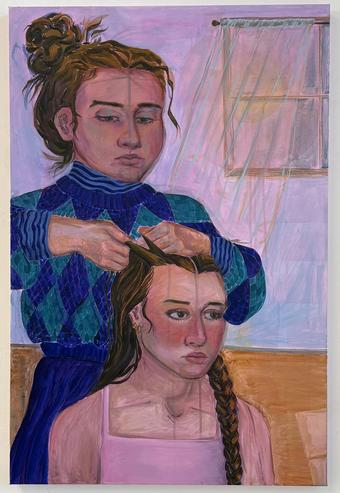
This piece is for my sister: growing up I always braided her hair before school, work, sports. I have done it for years and have become an expert at her very particular requests. However, now she is graduated, possibly moving away for school, and doesn’t need me in the same way. This piece was created to capture the love I have for my sister, the worry and excitement I feel for her future, and how much I am going to miss her and our daily rituals.

Description of the creative process:
When starting this piece I gathered inspiration from old photos and my sister and my closets. I wanted to emphasize our differences while exploring colour and likeness. During the process I wanted to capture my sister and my appearances without being to precious about realism. I wanted the colours to be light and airy. I tried to use the colours to emphasize transparency and light in the work to capture the feeling of fleetingness, like reflecting on a memory. I used very thin washes of paint to maintain the transparency and brushstrokes throughout the painting. 

The store

Artwork: The Store

Technique: Oil paint
Size: 36" x 36"
Year: 2026

Description of artwork:
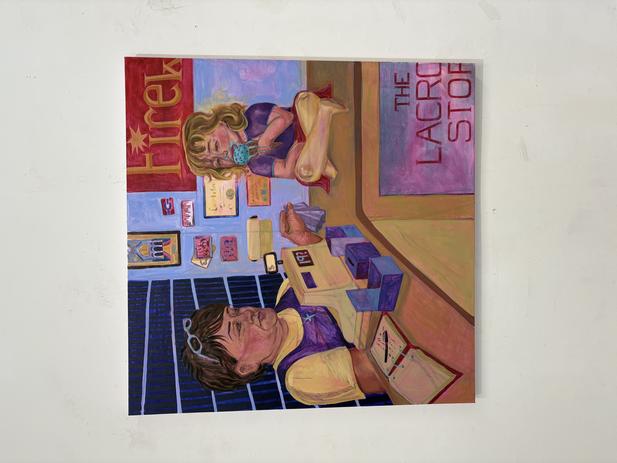
The work was created to honor my childhood. These memories are profoundly sentimental, irreproducible and my most cherished. When I was young, my Mamere owned a corner store in her small town. I used to spend a lot of my time there in the summers “working” and it was my favorite thing. The older I get the more these memories become fuzzy and faded. I remember life at the time was so saturated, warm and sweet. I tried to capture that essence in this work so I could keep it forever. 

Description of the creative process:
This work was painted from a compilations of family photos. I collected them from my personal albums and a few from my aunts’ photography archive. I used those references, along with some creative liberties from memory, to create the framework for the piece. I used vibrant colours, pinks and blues, to capture the whimsy of childhood. Moreover, I used thin laters of paint to capture light and tenderness in the skin and environment.

About the Artist

A bit about yourself:
I am a twenty-year-old painter and illustrator. I have been making art as long as I can remember and have always felt a drive to create. I am passionate about rock music, poetry and 90’s cult classic movies. I am in school to become an art teacher. Whether for children or adults, I think the arts are a crucial element of society and personhood and I think they should be fostered in a less technical, more creative way.

If you could meet any artist dead or living, who would it be?
I would love to meet Gustav Klimt. I am hopelessly obsessed with his use of pattern and colour. I would love to ask him questions about how he exaggerates the human form and where he derives his inspiration.

How has the visual arts department helped shape you as an artist?
The Visual Arts Department has connected me with so many incredibly creative, unique and talented artists. Everyone's brain works completely differently and it has made me so inspired. I love looking at everyone's work and hearing about their processes. Moreover, the Department has made me more confident in myself and my style as an artist by not confining the meaning of “good” art into such a narrow definition.

Myriam Audet

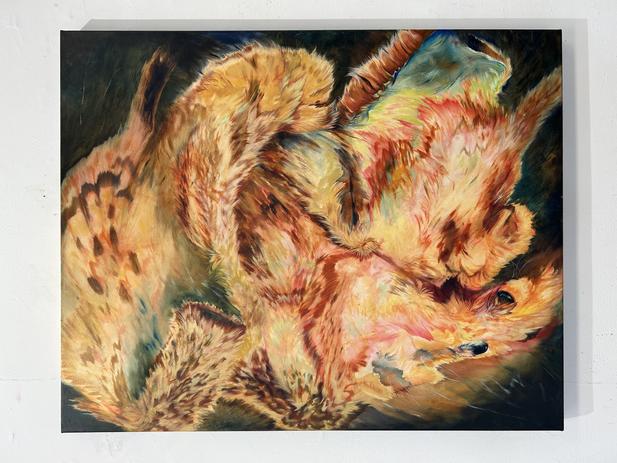
Grand-mère

Artwork: Grand-mère

Technique: Oil on canvas
Size: 31" × 39"
Year: 2026

Description of artwork:
This work features an abstract image I created from observation of my grandmother’s lynx fur coat from the 1970s.

Description of the creative process:
I chose to paint this object because, to me, it evokes a powerful energy that’s trying to come back to life. I wanted to show the world the imperceptible vision I had of the object and to create a living, animated image of an inanimate object made from now-dead animals. The work also speaks to the connection I forged with the object over the many hours I spent observing it, constantly placing it in new positions and at new angles so I could capture its full essence.

About the Artist

A bit about yourself:
I’m a Franco-Ontarian student and artist, and I’m going into my last year of the Bachelor of Fine Arts. In my current work, I select and carefully observe objects, looking first and foremost for the life in non-living things. That then inspires the rest of the scene to be depicted in the image. I’m motivated by the gap between reality, the way I see things and the way others do, and by translation through creation.

If you could meet any artist dead or living, who would it be?
I’d like to meet Francis Bacon, especially so I could learn the secrets of his experimental recipes for materials. For example, there’s a story that he’d heat up ground pastels in a pot. Why? I don’t know. The way he used media is fascinating to me because I’m really interested in the materiality of a work too, but in a very different way than he was (I usually paint in multiple very thin layers, focused on the different levels of opacity of the pigments). I’m also intrigued by how Bacon translated what he observed, especially through photography. 

How has the visual arts department helped shape you as an artist?
The resources the department provides have made me more disciplined and motivated. I was shy when I first came here, but the many studios and extensive workspaces have allowed me to create without restrictions (in terms of time, space and mess) so I could take my place in an environment where anything is possible.

Narcisa Puf

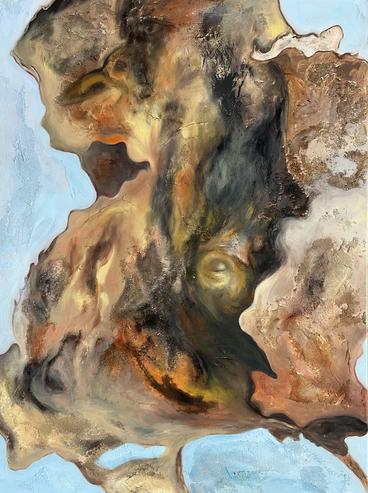
The Life Within

Artwork: The Life Within

Technique: Oil on canvas. Pumice stone for texture. Brushes and spatula.
Size: 40" × 30" × 2"
Year: 2026

Description of artwork:
The Life Within explores the silent presence of life through a dried leaf. The leaf becomes a symbol of change and continuity, connection and interdependency, revealing a delicate but fundamental beauty.

Description of the creative process:
The process started with observing a dried leaf found on a bookshelf in my workshop. I viewed it not as something dead but as a form that still contains life and continues to change. I worked with textures to create a geological look, adding a tactile, organic dimension and letting the material be part of the image. I kept the strokes free, guided by intuition, to progressively reveal an inner presence rather than defining what it was.

About the Artist

A bit about yourself:
I’m an exploratory artist. I often work in series where I try to establish a link between the shapes, the material and an inner thought. I put strong emphasis on intuition and strive to go deeper with conceptual thinking. Nature, the body and time are major inspirations in my art.

If you could meet any artist dead or living, who would it be?
I’d like to meet Marlene Dumas because of the way she works between presence and erasure. The emotional intensity and the free brushwork in her art move me. She manages to create images that seem delicate and powerful all at once, which dovetails with my own research on unstable presence and transformation.

How has the visual arts department helped shape you as an artist?
The department has helped me to think more deeply about my work, especially by encouraging me to think in terms of series and narrative structures. I’ve learned how to articulate my ideas better and tie my works together. The environment has enabled me to go from working intuitively to adopting a more conscious, conceptual process.

Yousra Nimour

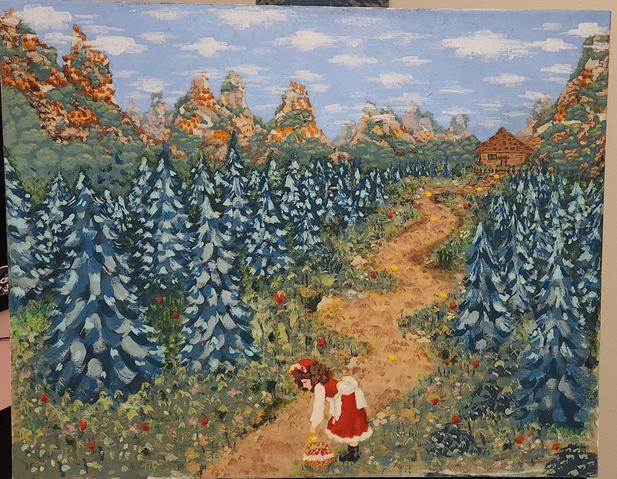
The Big Bad Wolf

Artwork: The Big Bad Wolf

Technique: Layering, stippling, underpainting
Size: 30" x 24"
Year: 2025

Description of artwork:
The focal point is Little Red Riding Hood, who is bent down reaching for a gold coin. The coin is one of several others lined up, one after the other, along the trail to her grandmother's house. There is a forest surrounding the trail, with mountains with little houses way farther in the horizon. The wolf is very tiny and hidden among the trees; can you find him?

Description of the creative process:
What inspired me to make this painting was an event I experienced in which I viewed myself as little red riding hood (one of my favorite fairytales) and someone I highly valued as the wolf. I started this painting by creating an underpainting with watered down acrylic paint, then I began layering colours on top of each other until I achieved a desirable form. I had two references, one for the mountains (a picture I had taken of the Kabylie mountains in Algeria) and a painting i had seen at the gallery which I don't know the name of.

About the Artist

A bit about yourself:
I'm 21, Algerian, ultra leftist, hardcore feminist, working class, lower class, bilingual (French + English)

If you could meet any artist dead or living, who would it be?
Sophia Jackson and Anselm Kiefer.

How has the visual arts department helped shape you as an artist?
The Visual Arts Department has pushed me to dabble into mediums I had never even heard of before, much less would have ever worked with, like clay, wood, metal, acrylic mediums, and so much more. I'm also inspired by all the art and artists I'm surrounded with; it motivates me to keep making art. The Visual Arts building is unique, in the sense that community is easily formed since the building is relatively small and we're aways working in it. It feels almost like a second home to me.

Zinnia Plumb

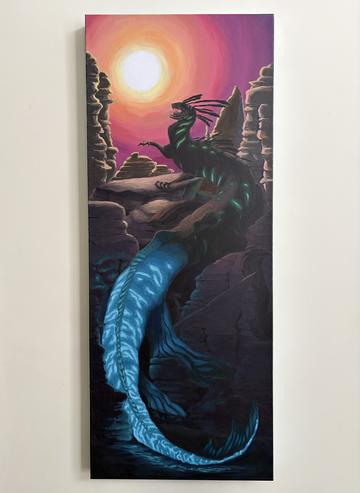
Reaching

Artwork: Reaching

Technique: Acrylic paint
Size: 40" x 16"
Year: 2026

Description of artwork:
Achieving goals changes people, either for the better or for the worse. Often, you are unable to go back to what you used to be.

Description of the creative process:
First, I started with the canvas and an idea of the concept I wanted to paint, then figured out what kind of creature would fit. I then painted in sections, adding the glowing elements last as a way of showing the full effect of the change.

About the Artist

A bit about yourself:
I primarily work in acrylic paint, and enjoy figuring out how strange creatures can convey aspects of the human experience.

If you could meet any artist dead or living, who would it be?
I would like to meet Monet, as he was an important inspiration for me in high school as I got back into painting. Although I’m leaning away from impressionism, I still find the technique to be fascinating. 

How has the visual arts department helped shape you as an artist?
The Visual Arts Department has reminded me to try new techniques of creation, instead of staying with the same thing every time. Also, it has allowed me to be inspired by my peers and what they create.

Zoé Geisler Lamonde

Mariage

Artwork: Mariage

Technique: Acrylic on canvas, painted in multiple thin, transparent layers, with a single coat of gesso.
Size: 24" × 20"
Year: 2026

Description of artwork:
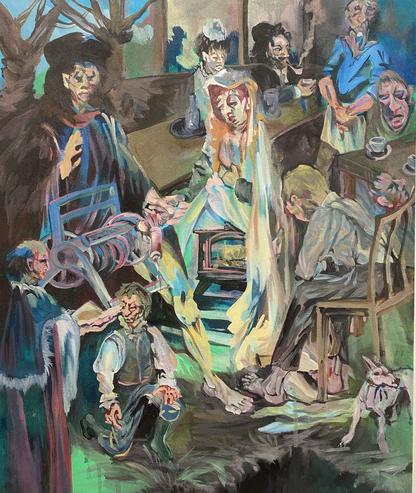
As with the first work, this painting depicts images that are familiar to us, especially in Canada and especially for viewers who have studied art history. It explores the concepts of appropriation, art history and narratives, particularly around marriage. The main figures are a man and a woman, with several other recognizable figures around them. A mix of indoor and outdoor spaces is also visible. Lastly, the work shifts between areas that are very detailed and areas that are almost abstract, or deliberately unfinished.

Description of the creative process:
This work builds on my study of visual arts encyclopedias. In them, I examine works spanning from the paleolithic era to postmodernism. I created this work alongside three others in a similar format. Together, those four pieces explore recurring categories I’ve noticed during my research: marriage, science, the resurrection of Christ and war. On top of a layer of fluorescent green, I added the figures one by one, progressively building a new narrative that would encourage the viewer to think about marriage and how it’s represented.

About the Artist

A bit about yourself:
I’ve lived in Ottawa my whole life, and I’ve always been interested in the arts. When I was young, I went to art camps and schools, which fuelled my art. My work is mainly in acrylic paint. I just finished my third year in the Bachelor of Fine Arts. I’ve also been part of a few exhibitions, including at Art Mûr and Gallery 115 at uOttawa. Right now, I’m exploring issues surrounding history, memory and culture in connection with nature.

If you could meet any artist dead or living, who would it be?
This is a really tough question, but I’d definitely choose Max Ernst (1891–1978, German painter, sculptor, printmaker, sketch artist and poet). He was my first artistic mentor, and I can always look back at him to find new works and ideas. He remains a constant source of inspiration to me. Ernst is part of the surrealist movement, which I’m especially interested in. But what inspires me most about him is his unquenchable thirst for exploration and discovery: he experimented with countless techniques and media, producing a remarkably diverse range of work and encouraging artists not to limit themselves to just one style.

How has the visual arts department helped shape you as an artist?
The department has provided me with a space where I can meet, collaborate with, talk to and draw inspiration from other artists who, like me, want to expand their knowledge and skills or even pursue a career in art. Since I started university, I’ve learned how important experimentation, play and chance are in creation. These are approaches I never would’ve thought to use before. Besides this, I’ve learned not just new techniques and theories but also the importance of the audience and presentation. Finally, the professors and art history courses have helped me keep an open mind and be experimental in my work. The department has given me the opportunity to be around artists of all ages and levels, professors or students, within a small and very supportive community. The fact that it’s small has also offered me a lot of freedom.