

The Doctorate in Law (PhD) trains the next generation of academics and high-level jurists, able to advance the frontiers of their discipline through rigorous theoretical, practical and empirical research. Offered jointly by the Common Law and Civil Law Sections, this program gives you the opportunity to carry out innovative work in the heart of the national capital, in a unique intellectual environment where Canada's two major legal traditions engage in dialogue.

Firmly committed to excellence, this program aims to instill mastery of a sharp methodological approach and a critical mode of legal reasoning, deeply rooted in contemporary social issues. To ensure the success of your contribution to knowledge, you benefit from tailored supervision: from your very first term, a thesis advisory committee, made up of experts who share your fields of interest, guides you step by step along your path.
Why Choose This Program?

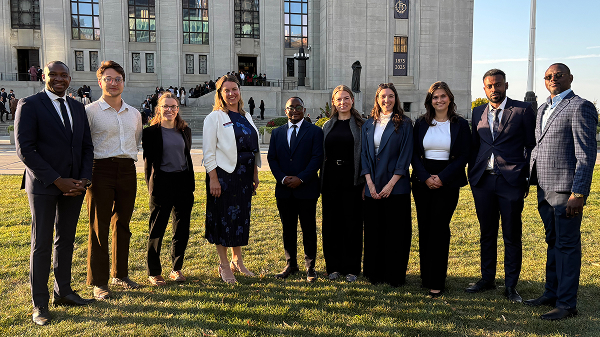
PhD Students with dean Boon

The doctorate is for those who want to devote several years to a fundamental question and contribute, through an original thesis, to the advancement of law. It is the training path for researchers, law professors, and high-level jurists called on to think about law as much as to practise it.

Three features set the program apart. First, its bijural and bilingual grounding, which gives access to the scholarship and methods of both Canadian legal traditions. Second, its location in the heart of Ottawa, steps from the Supreme Court, Parliament and the federal institutions, an environment well suited to research in public, international or comparative law. Third, its supervision, structured around a thesis advisory committee that follows you from the first term to the defence, and supported by recognized research centres (human rights, law and technology, children's rights, among others).

Program Structure

The doctorate runs over four years (with a maximum of six, or seven in the case of an accelerated transition from the master's). It is built around successive milestones rather than a list of courses.

  • Coursework: a course in legal research methodology and theory (DCL 8330) in the first term, then an elective in the second, chosen in relation to the thesis proposal and approved by the program's director.
  • Directed readings and comprehensive examination: directed readings (DCL 9998), chosen with the thesis advisory committee, allow you to acquire the theoretical foundations of your field. They lead to a comprehensive examination, written and then oral.
  • Thesis proposal: in the fifth or sixth term, you present your thesis proposal (DCL 9997), in writing and orally, together with a detailed plan and a comprehensive bibliography.
  • Thesis: from the sixth term onward, the writing of the thesis (THD 9999), usually 90,000 to 120,000 words, through to its defence before a jury of four members.

A thesis advisory committee is formed in the first term, composed of your supervisor and two to three additional professors. It guides you at every stage and meets with you at least once per term.

For full requirements and course details, consult the official program requirements in the University of Ottawa catalogue.

Admission Requirements

To be eligible, you must:

  • Hold a Master of Laws (LL.M.) from a Canadian university, obtained with a minimum average of 75% (B+) calculated according to graduate studies guidelines, or an equivalent foreign degree in law with results deemed comparable, and have already demonstrated legal research and writing abilities;
  • Have sufficient knowledge of French or English. Foreign students whose first language is neither English nor French must provide proof of proficiency in one or the other language, according to the terms set out in the general regulations in effect for graduate studies (Section A).Transfer from master's to PhD

Exceptionally, a master’s student may be admitted to the doctorate without having completed all the requirements of the master's, with the approval of Graduate Studies in Law. This requires having completed at least three master's courses with a minimum average of 80% (A-), obtaining that approval, and meeting the other admission requirements for the doctorate.

Applications are submitted online. For deadlines, language tests and other requirements, consult the specific requirements.

Finding a supervisor

Admission to the doctorate requires that a faculty member agree to supervise your thesis. Before applying, you are strongly advised to identify professors whose work intersects with your project and to contact them. The list of professors and their research fields is available on Teachers.  

What You Can Do With Your Studies

student working at computer

The doctorate prepares above all for careers where research and high-level legal expertise are central:

  • law professor in a university
  • researcher in an institute, research centre or international organization
  • expert jurist within a government, a court or a regulatory body
  • policy adviser on complex legal issues
  • senior consultant in fields requiring specialized expertise

Financial Support

Internal Scholarships

Funding is an essential dimension of your doctoral path. That is why the Faculty of Law and the Office of the Vice-Provost, Graduate and Postdoctoral Studies award admission scholarships each year. Your file is automatically assessed for these scholarships by the Admissions Committee, with no additional step on your part. Please note, however, that other scholarships, funded by generous donors, require a separate application.

External Scholarships

In parallel, we strongly encourage you to apply to the major granting agencies, such as the Social Sciences and Humanities Research Council (SSHRC), as well as other sources of funding. To explore the full range of external scholarships and access the relevant forms, we invite you to consult the Awards Office of the Office of the Vice-Provost, Graduate and Postdoctoral Studies.

Contact us

Office of Graduate Studies

57 Louis-Pasteur st.,
room 301
Ottawa, On K1N 6N5

Tel.:  613-562-5774
[email protected]